カテゴリー: メディア・掲載記事

  • “Places We Remember”by Hal Drake

    “Places We Remember”by Hal Drake

    I once owned a chip off a cornerstone of Japan’s economic miracle. It was lost long ago, alas. It was so simple, fashioned by proficient fingers and sold for easy profit—an old fashioned phonograph, of the kind wound up by teachers to bore kids during music-appreciation hour. But this one had a small, battery-powered amplifier and three spatula-like prongs that folded out to make a turntable. No heavy cabinet or complicated console. The whole thing folded up to be carried like an attaché case, an ancestor of the boom boxes that bother Sunday morning sleepers today.

    I wonder how many of those the Japan Victor Co. sold? How many GIs like myself, on R&R from Korea, bought one to take back to a bunker or tent, to be played and broken or abandoned.

    The $14 I paid to take it out of a Yokohama shop was my small contribution to that miracle, along with the 100YEN apiece I gave to two schoolboys who battered my boots with a shine brush outside Yokohama station. I have to wonder if they now own auto agencies or hotels.

    I did something else that trip. I rode a coal-powered cab, one of the fume-spitting flivvers that ran off what the driver shoveled into the stern.

    They mottled the skyline but in those days, nobody worried about pollution. If I had that phonograph now or came by one of those cabs, I think I’d donate them to the Museum of Natural History as an example of how sheer human effort can be a bridge from poverty to profit. Few, if any Americans, certainly not a 21-year-old soldier, could feel the changes pulsing through Japan, or imagine that a recovered adversary would soon be a close ally and resented trade rival.

    P20.

    There was an American Chamber of Commerce in Japan, four years old then, but uniforms still outnumbered business suits. Most Americans lived a sheltered and comfortable life, on military compounds or grounds that had been commandeered or reclaimed, such as the old American Club, founded in 1928 and refounded in 1948.

    Every comfort and convenience was close at hand-Mars bars, an American newspaper, a British-style tabloid, even a constant American voice on the radio.

    That’s the first thing I recall hearing when I came back as a civilian in 1956—the brush-on-canvas voice of one Walt Sheldon, a very professional Far East Network broadcaster who could do anything from a stacatto newscast to a well-modulaed hour of classical music. He was often seconded by chirrupy-voiced Hiroko, who joined Sheldon in relating lore and culture.

    “Mister Sheldon, why do Americans say ‘square meal’?”

    “Why, I don’t know, Hiroko, being as they re mostly served on round plates. And now, it’s time to Enjoy Japan…”

    And there would be bowl games and title fights, State of the Union from a succession of presidents and the entire Series, short-waved or transcribed — always direct after satellites were launched.

    It was lavishly typical of Americans to import the comforts they couldn’t do without, and so it was with FEN. First born at NHK, it was seized as war booty in 1945, then moved to United Nations headquarters at Ichigaya and finally to outlying bases allowed by the Japan-U.S. Security Treaty.

    There was an odd mixture of talent at FEN micro-phones: seasoned pros like Sheldon, drafted farm boys with dry drawls, a Cajun whose speech sounded like Deep South, and Brooklynese, along with some well-remembered local productions.

    There was that time, around 1947, when a terse bulletin broke into a musical interlude, telling of how a sea monster had raged ashore at Yokohama and was trashing the town. Later bulletins attested that it was trampling police cars and kicking aside barriers, and stomping straight down the highway to Tokyo. A between-us-Yanks joke was lost on the Japanese who believed every word. Police were marshaled. Local citizens seized up clubs and axes.

    Finally, the monster reached the capital and ambled up to the FEN microphone, consenting to an interview.

    “Oh, I’m the Reluctant Dragon…” It was a tune from an old Disney cartoon.

    The next day, some FEN pranksters traded their mikes in for mops.

    But on another night, the bulletin was urgent and authentic. A Japanese fuel dealer had sold an American businessman what he thought was kerosene for a space heater, discovering later that it was high-octane gasoline that could reduce a small wooden rental to blazing splinters. Frantic, the dealer called the police who contacted FEN, and that customer heard the warning just as he was about to light his heater.

    FEN was founded and run for overseas troops and military families, although anybody could listen and everybody did. That made network officials cautious about what was broadcast. They had to be careful with “Tokyo Calling,” a long Sunday afternoon of news, music and vintage radio shows, some of which went back to the war years.

    Fibber McGee and Molly might suddenly joke about Victory Gardens and sugar rationing, or a racial slur could slip out, such as the time Billy Mills and the King’s Men sang a robust song that warned Japanese they were foolish to “pick a Yankee target,” using that wartime epithet for Japanese. There was surprisingly little flurry about that.

    Although I was told that FEN Program Director Milt Radmillovich was absolutely furious.

    And there were the English-language newspapers, folded beside breakfast napkins or seized from rush-hour vendors on train platforms. The Japan Times, a descendant of the pre-war Advertiser, was a comprehensive mosaic of international and business news, a rival of the Daily Mainichi that was more local than global.

    The Japan News, which became the Daily Yomiuri, was back then a British-style tabloid that could be folded double and read standing up on a crowded tram. It was full of British news, British features and an engaging comic strip called “Jane,” whose heroine ran naked from panel to panel.

    The most American newspaper, of course, was Pacific Stars and Stripes, founded as a contemporary of FEN in 1945. It kept far-from-home Gls and other Americans fully informed on the doings of Harry Truman, Winston Churchill, Elizabeth Taylor and Willie Mays.

    Stripes was written and laid out at the Japan Times and printed several blocks down at the Asahi Shimbun, going from commandeered presses into military hands and, at some outlets, the expanding commercial community. It was all there—the Joe Louis-Billy Conn fight, the arrest and trial of Japanese accused war criminals, the looming crisis in French Indochina.

    The Asahi Evening News certainly had the best roundup of worldwide editorial opinion and good domestic political reporting. Those who had more than glancing contact with the press might wander into No.1 Shimbun Alley and rub shoulders with the deadline literati at the Foreign Correspondents’ Club of Japan-good food and grog, cold Kirin at the turn of a spigot. But drinking there frequently meant listening to the bitter miseries of frustrated professionals who jousted with authority about what could be learned or printed.

    That authority, of course, was General Douglas MacArthur, the American shogun who ruled from a castle beside a castle, pacing a well-worn rug in his office at the Dai-Ichi Building across from the Imperial Palace. He fashioned the policies and directives that would reform Japan and assist its economic recovery. MacArthur insisted that Japanese products, such as transistor radios, be pushed across PX counters. At the same time, he imported quality-control experts who banished production-line chaos and taught workers the organization and teamwork we see at Sony and Toyota today.

    MacArthur’s policies were arbitrary and dicta-torial, but they got results. In 1952, Toyota turned out its first postwar auto—a wide-axled roadster that might have been fashioned in the mid-1920s and looked to many as if it should have been horse-drawn rather than motor-powered. How many scoffing Americans saw that and confidently counted Japan out as a competitive force in the automotive market?

    Occupation traces were vanishing, but ever so slowly. There were still street signs and traffic markers in yellow and black, the signet colors of the Army Ist Cavalry Division that ran the town like a medieval estate and proudly stepped off in the annual Fourth of July parade across the Imperial Plaza.

    A day off or a night out? Well, there were the movie theaters— old, large palaces like the Yurakuza, which had once premiered silent classics like “The King of Kings” and now showed “My Darling Clementine” or “The Return of Frank James,” perhaps a popular prewar feature like Jeanette Mac-Donald and Allan Jones in “The Firefly.”

    There was music, too, and not just the wail of a reed flute. Brassy jukebox fare and git-fiddle country blared over FEN. Entrepreneur Eloise Cunningham defied Occupation frowns on fraternization to organize her Music for Youth concerts, bringing Japanese and Americans together for the thrill of Vivaldi and the thunder of Beethoven-even though MPs might show up to pry her patrons apart. I recall, as I worked at Stripes, that Eloise came in every year with particulars on her next concert, an annual pain but a benevolent one.

    Before the baton went up, concert goers might meet at International House, which had garden-like grounds, reasonable accommodations and a fine library. Academics from India and Idaho mixed easily. One frequent patron, Donald Richie, would become film curator at the New York Museum of Modern Art and was the last-word authority on any movie made since the days of the hand-cranked camera.

    A place to eat was no problem. Tokyo abounded with good restaurants then, enjoyed without second-mortgage expense. A rare and succulent steak at the Tokyo Plaza, with baked potato and trimmings, cost all of ·3,000-cash that wouldn’t get you past the potted palms of any classy place now. Peasants like me patronized Charlie Manos Russian restaurant, where luscious piroshki cost $50 and a diner down to his last ·500 could eat lavishly well.

    Close to the complex of theaters at the Shibuya Pantheon was a long alleyway of sushi counters.

    Maguro (tuna) went as cheaply as 40yen a mouthful – a steerage-class smorgasbord.

    At the Rhinelander in Kasumicho, a former professor of German literature at Niigata University puffed a meerschaum and frowned over his chessboard as customers savored delicious schnitzel and draft beer that was rich and cold.

    There was a fine engraving of a dignified 16th century elder on the varnished oak wall, a classicist Doktor Karl Fischer venerated.

    “Mozart?” I inquired innocently.

    “Goethe,” Fischer corrected sharply.

    Close to the Ginza was Ketel’s, founded by a former German colonist in the Kaiser’s concession at Shantung. Captured when the Japanese joined the Allies in World War I, Ketel was shipped to Japan, taught his captors the butchering trade and wound up opening a first-class eatery. His daughter, a natural hostess, served up juicy knockwurst with mashed potatoes and sauerkraut, a kind of Bavarian bangers and mash. I liked the steeped-in-history feel of the place.

    My favorite was the long-gone L’Ambre in Shibuya, with a came of a frowning Beethoven on the door and a kind of Carnegie Hall atmosphere inside. Raptly silent patrons applauded the classics and there was always that one old fellow who waved an imaginary baton as he paced Stokowski and Toscanini.

    Night life? Well, it varied. There were pricey places like Manuelas and the Latin Quarter, which were really for the expense-account trade, more affordable bistros like the 88, where you could hear prime-cut jazz by Larry Alley or Billy Banks, the brassy humor of Kenny Pierce or the music-hall banter of Leo Prescott. Al Shattuck ran a lively and reasonable place.

    Oh, yes, there was cold draft and a slapped-off-the-grill burger at the Hamburger Inn, or Harry’s Bar, which should have been laminated as the first authentic GI bar in metropolitan Tokyo. A few alleyways from Roppongi corner, Harry’s held its ground for years as other GI places, such as John’s Bar, folded and vanished, and was a dying curio in its final days.

    Change was constant and expensive, particularly as there were deliberate assaults on the strong dollar. People clung to life raft places like Chaco’s Steakhouse and Tony Romas, if they dined out at all, and memberships in the Tokyo American Club were valued more than ever. It was all there in one business-or-family package, from boardroom to ballroom, the Garden Café and Foreign Traders’ Bar, swimming pool and video tape library.

    Comforts could be preserved, contained and shared as Americans mingled with Japanese members and those from 50 other countries. American members were fewer as home-office accountants groaned over expense wrought by a stronger yen.

    It was no longer easy to place a daughter in the gentle hands of Sister Marie d’Huart at Sacred Heart or a son through the conscientious education and drill-sergeant discipline of Brother Andrew at Saint Mary’s.

    The dollar depreciation was a hard blow to the American School in Japan, which turns 75 this year. Founded for children in the foreign commu-nity, it has also welcomed Japanese, every semester a strut in a cultural span. My youngest son went there, from grade nine through graduation, and I must still commend the patient and dedicated effort of headmaster Ray Downs to educate a youngster who was too often more interested in karate than the history of mathematics.

    I lived right next to the campus and loved those fund-raising carnivals, where Bozo the Clown might make a surprise appearance and you could buy flea-market odds and ends and a mustard-slathered hot dog from a portable stand-genuine and authentic Americana in Japan.

    Not that I ever ignored that outdoor food bazaar at Sacred Heart—the scent and taste of Indian curry and Korean bulgogi, washed down with New Zealand Steinlager. I was close to that place because I was close to Mary and Corky Alexander, who sent four daughters there.

    Corky was an old friend and longtime professional colleague when he decided the foreign community needed a clarion, a weekly newspaper that would be its voice and chronicle in Tokyo. He started out on shoestring savings and investment, knocking on a lot of doors.

    We all wished him well but had misgivings, having seen so many such efforts founder and crash. But I wrote, for that first Tokyo Weekender and write for it still, through the 26th anniversary of a successful ambition. The Tokyo Weekender looks set for the next millennium and beyond.

    So many changes in so many years, or perhaps so few, moving so fast after those first few foreign tradesmen landed in 1945.

    Time turns backward for nobody, so I can never again savor that first-morning ride from Haneda, through an industrial suburb and down the Ginza.
    Moored balloons still bobbed from the rooftops of theaters and department stores, trailing streamers that looked like rope ladders, lettered with characters extolling this attraction or that product. “Oh!
    Rosalinda!” was playing at the old Theatre Tokyo, and a painted mural beckoned people to see a stage musical at the Takarazuka, once the Ernie Pyle Theater.

    Later, I took a long walk through the back alleys of Ginza, first passing kids in school uniforms who were lined up to see a French film with Jean Gabin.

    I moved on to my first doubtful and cautious taste of raw tuna at one of the small sashimi shops, and passed a Buddhist temple to hear, for the first time, the atonal chant of the sutras.

    Four blocks later, I stopped to hear, unbelievingly at first: “Yah!” Stomp! Stomp! “Das ist die Lichtensteiner Polka, mein schatz!” and I walked down a flight of stairs to find a rathskeller that might have been brought plank-and-nail from Munich.

    I told myself then that I was in one of the greatest towns in the world.
    It was, and still is.

    Hal Drake first saw Japan on his way to and from the Korean War. He joined Pacific Stars & Stripes in 1956, working in Japan, Korea, Okinawa, Thai-land, the Philippines and Vietnam. He went on to become a senior writer and columnist for the paper, until retirement in 1995. He is currently chairman of Netword International in Australia.
  • ハル・ドレイク氏出版記念パーティー

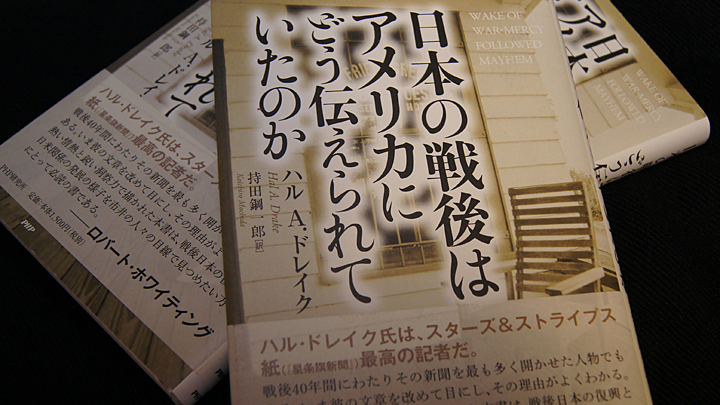
    『日本の戦後はアメリカにどう伝えられていたのか』(著)ハル A.ドレイク(翻訳)持田 鋼一郎(2008 PHP研究所)

    写真:(著)ハル・A・ドレイク『日本の戦後はアメリカにどう伝えられていたのか』

    以下、アマゾンより引用:

    敗戦直後の日本の市井の人々に流れたもう一つの時間。日本の戦中、戦後はどうアメリカに伝えられていたのか?
    戦後の日本の混乱・復興期を見つめてきた『星条旗新聞』記者の手記をまとめる。

    歴史はともすれば、勝者の観点からの史実のみが語られることに陥りやすい。
    あの戦争当時には口にできなかった言葉も、時を経たことによって、話すことができる。
    戦中、戦後の様子を市井の人々は、どう見て、何を感じ取っていたのか?
    一人のアメリカ人ジャーナリストが彼らを訪ね歩き、聞き出した彼らの当時の思い。

    ◎二・二六事件を目の当たりにした山王ホテルのホテルマン
    ◎夫と観るはずだった映画を戦中見ることなく、学徒出陣で夫との別れを迎えた婦人の思い、
    などなど。これまで語られることのなかった歴史の欠片(かけら)を丁寧に拾い集めるかのように綴ったノンフィクション。当時の彼らの目に映ったもうひとつの歴史の一面を垣間見ることのできる秀作。

    Amazonで調べる


    著者紹介・書籍の帯コメント

    ドレイク,ハル・A.
    1930年5月2日、米カリフォルニア州サンタモニカ生まれ(LA育ち)。ロサンゼルス市立大学卒業。1951年より約1年間、朝鮮戦争従軍。1952年末、国防総省準機関紙―Pacific Stars and Stripes(『星条旗新聞』)の記者として東京に赴任。以後1995年末に退官するまで、日本の戦後の政治、経済、社会面での取材と同時に、極東での幅広い報道を手掛けた。特にベトナム戦争への特派員としての報道の評価は他を抜きんでている。歴代の米国大統領、ローマ教皇を含む各国VIPの来日取材、芸能・スポーツ関係での「ハリウッド」「エルビス・プレスリー」特別号、モハメド・アリ、マイク・タイソンらをインタビュー。試合報道、多彩な才能を発揮し、読者を魅了した。記憶力、文体の美しさは、数あるジャーナリストの中でも特記され、持ち前のユーモアと温厚な人柄は、『星条旗新聞』の名物記者の異名をとる。オーストラリア・クイーンズランド州、ゴールド・コーストに在住し、日豪の掛け橋として、夫人と共に異文化語学教育を指導している

    ハル・ドレイク氏は、スターズ & ストライプス紙(『星条旗新聞』)最高の記者だ。
    戦後40年間にわたりその新聞を最も多く開かせた人物であり、いま彼の文章を改めて目にし、その理由がよくわかる。熱い情熱と鋭い洞察力で描かれた本書は、戦後日本の復興と日米関係の発展の様子を市井の人々の目線で見つめたい方々にとって必読の書である。――ロバート・ホワイティング

    英国の詩人オーデンが言うように「歴史は敗者に嘆きの声をかけても、許してもくれないし、慰めてもくれない。」しかし敗者を理解することのできない勝者ほど社会を見誤るものはないだろう。格差の拡大する社会とは、敗者の理解することのできない勝者の理解する極めて危険な社会である。敗者にも礼をもって接する日本人の伝統は、いつの間にか消されたか、消えてしまったのだろうか。(訳者あとがきより)


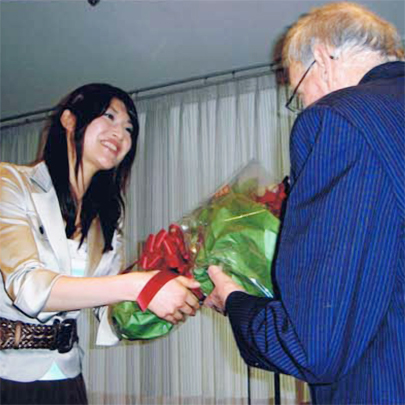
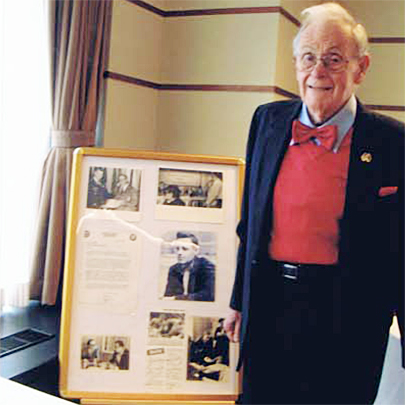
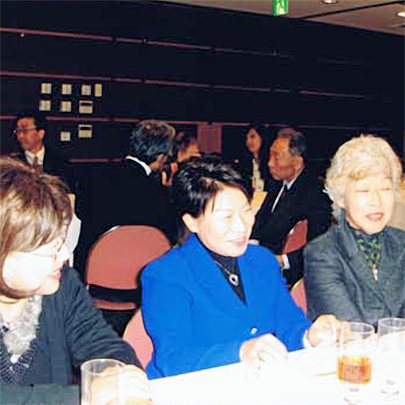
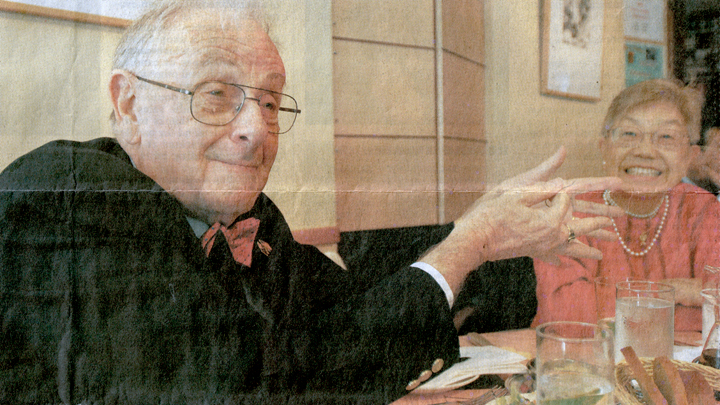
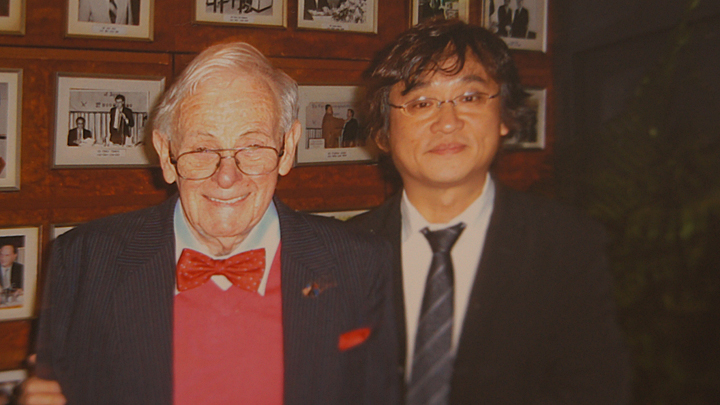
    ハル・A・ドレイク出版記念会

    外務副大臣:伊藤信太郎氏を迎えて
    “Wake of War – Mercy Followed Mayhem”

      Hal A.Drake Publication-Party

    • February 23,2009
    • Foreign Correspondents’ Club of Japan(Media Room)

    写真:ハル・A・ドレイク氏『日本の戦後はアメリカにどう伝えられていたのか』出版記念

    写真:ハル・A・ドレイク氏『日本の戦後はアメリカにどう伝えられていたのか』出版記念

    写真:ハル・A・ドレイク氏『日本の戦後はアメリカにどう伝えられていたのか』出版記念

    写真:ハル・A・ドレイク氏『日本の戦後はアメリカにどう伝えられていたのか』出版記念

  • Okinawa deserves to be free of the U.S. military

    『ネットワード・インターナショナル・サービス(以下、Netword)』会長、『パシフィック異文化教育アカデミー(以下、PCA)』学院長「ハロルド・A・ドレイク」がメディア掲載、取材等で取り上げられた記事を紹介致します。
    以下、掲載記事


    The Asahi Shimbun
    Monday, June 18, 2007

    POINT OF VIEW / Hal Drake

    Okinawa deserves to be free of the U.S. military

    Special to The Asahi Shimbun

    I believe the United States should pull its military forces out of Okinawa and leave the prefecture floating free and clear, with no defensive arms except those Japan’s Self-Defense Forces.

    When I joined Pacific Stars and Strips in Okinawa in 1956, there was an urgent and necessary need for American muscle on ground that we had recently savaged past the roots.

    There was that open wound called the Cold war, born soon after the last breath of the Battle of Okinawa. The Soviet Union was powerful and dangerous and had shown in Hungary it would go to brutish extremes to hold war-gotten gains. There was also the infected sore of North Korea.

    Both sides brandished nuclear spears. Was there only no-way-out way ahead? The astute American diplomat, George F. Kennam, held up a restraining hand. Relax that restless trigger finger, Kennan urged.

    Russia, ruled by a faulty system, was born for failure. Wait it out and let that happen. And so it would be.

    Okinawa was the last totally American ground in Asia, loosely granted something called “residual sovereignty.” The ground of Okinawas was theirs to walk on but not to govern. Americans did that, as they held a sturdy footing on a formidable base.

    Back then, Okinawa resembled a kind of little America, with Kentucky Fried Chicken and the massive face of Col. Sanders beaming over a highway. But the ruling presence changed many times, personified by a procession of generals. The general on the hill could be named Booth or Hood or Shapley or whomever.

    Few Americans could fault Okinawa as a training ground. It had the steep and rugged terrain of any bona fide battlefield terrain of any bona fide battlefield. And away from the maneuver smoke and crowded barracks, there were the rowdy bar strips of BC Street and Henoko.

    There were all kinds of bizarre diversions. At the Club Sahara, revelers watched bloody bouts between Horace Habu and Malcom mongoose, the natural enemies that abounded in cemeteries. The creatures were dropped into a transparent glass cage to fight to the death.

    “Next match is about to begin, folks. Which will win, the savage beast or the venomous serpent?”

    Animal rights activists were outraged, but those fights were humane in comparison to gruesome bouts between a lion and a dog.

    The best and worst of America’s young men came. There were some who looked after orphans or donated large sums to support homes for the elderly. Yet, there were reports of brutal rape. One rape of a 13year-old girl made world headlines.

    This was all done in imported neon that flickered over a counterfeit America, a place gradually transformed into an island-wide Japanese play land.

    The day of the GI dollar was coming to an end. The GI would soon be the out-of-cash customer who could not afford a cover-charge cabaret.

    Then came that abrupt transformation called Reversion.

    Okinawa was finally and at last part of Japan again, and islanders were no longer forced to forfeit even a centimeter of sovereignty.

    The Soviet Union, suffering from terminal political illness, put itself to death. North Korea suffers from its own chronic political failure. Post-Mao China takes care of itself and its own. Neither can afford the grief or expense of war.

    All has changed.

    But there are still foreign military forces on Okinawa, beyond the time or reason for being there.

    Yes, some may argue, Japan and America have critical and justified interests in Middle East oil fields, but both countries have the reach and strength to take care of them.

    As the times turn, I would like to see Okinawa at last be given the independent hand the prefecture has never had — and perhaps even take a neutralist stance, disarmed by choice and financially nourished as a free port.


    Hal A. Drake
    The author is an American journalist now based in Brisbane, Australis.

    掲載記事:朝日新聞【2007.06.18】

  • 朝日新聞「ドレイク氏インタビュー」

    『ネットワード・インターナショナル・サービス(以下、Netword)』会長、『パシフィック異文化教育アカデミー(以下、PCA)』学院長「ハロルド・A・ドレイク」がメディア掲載、取材等で取り上げられた記事を紹介致します。
    以下、掲載記事


    The Asahi Shimbun “Weekend Beat”

    FACE FROM THE PAST

    写真:Hal and Kazuko Drake
    photo(Takahiro Yanai / Staff Photographer): Hal Drake, joined by his wife, Kazuko, talks about being a reporter for the Pacific Stars and Stripes at the Foreign Correspondents’Club of Japan in Tokyo.

    When history ‘won’t let you alone’
    “I remembered they had nice women there,oh boy, and so that was it.”
    HAL DRAKE(Journalist)

    By JEREMEY LEMER
    Contributing Writer

    looking back over a life spent as a reporter in Japan, Hal Drake’s conversation skips from friends long dead to visions of war and reconstruction to the soldiers and sailors who have peopled his stories. Memories of face, noises and smells pour out in an urgent, tumbling stream, lubricated by a generous portion of gin and tons.

    Now in his 70s, Drake was barely 26 when he first came to live in Tokyo in 1956 to work for the Pacific Stars and Stripes, the U.S. military’s unofficial newspaper. By then World War II had been over for more than a decade, and Japan, newly returned to self-rule, was beginning to shrug off year of U.S. administration.

    Those were heady times for a young man from southern California, and Drake’s Japan was and will always be that of the postwar period, with its bombed-out cities and febrile reconstruction, the pulse of history beating in every corner and alley.

    He recalls Japanese workers on U.S. Army bases were still stealing discarded food to feed family members and friends. Shinbashi was “wild and booming” and U.S. military personnel could still enjoy the “comforts” of the occupation — servants and private clubs.

    Indeed, Drake didn’t come to Japan “to engage myself in culture and everything,” he said mischievously. “I remembered they had nice women there,oh boy, and so that was it.” His plans were short term, with no eye on a permanent career. He also didn’t plan to get married. “but it happened twice — one was disastrous and the other has worked out fairly well,” he said, gesturing to his Japanese wife, Kazuko, who sat opposite him at the Foreign Correspondents’ Club of Japan in Tokyo.

    In his articles, Drake probed beneath the dazzle of that era though, and his stories are haunted by the ghosts of the great conflict that destroyed and created in equal measure. Some ghosts were laid to rest, some were forgotten, but other wandered still. Like Teizo Morita, an admiral who headed the Japanese Imperial Navy’s Force Repair Department during the war, only to wind up a night watchman in an auto agency — “a baton of high rank” replaced by a “flashlight.”

    “This type of stuff, I kept running into,” Drake said. “History just won’t let you alone.”

    And the past few months have proved his point. In August, several of his old articles were translated and republished in the Yomiuri Weekly, as part of look back at Japan’s postwar years. In September, he was interviewed about his recollections of Iwojima island by Yomiuri Shimbun in the run-up to the release of Clint Eastwood’s films about that epic battleground.

    Still, the embrace with history is a mutual one. Despite retiring to Brisbane, Australia, in 1996, Drake was back in Tokyo in early December to talk to publishers about a collection of 25 of his best articles that he hopes to bring out in the near future. For the most part, they are profiles of men and women marked by World War II — a war Drake didn’t cover, but seems unable to forget.

    “Young Japanese people don’t know the war,” Kazuko Drake said, and she would like to change that by using Drake’s journalism to bring the era to life again. Drake, too, is determined to recover what he considers to be the lost voices of a significant period. “Many are vaults of stories seldom told or never told,” he writes of his subjects in the introduction to his collected articles, “I couldn’t throw them in the back drawer of the past and slam it shut.”

    Drake cannot forget the past, but he can forgive. His published work shows a touching in sight into the process of reconciliation between former enemies, In one story, the brother of a U.S. pilot shot down in combat meets and pardons his brother’s killer, a Japanese fighter ace who renounced violence after the encounter and spent the war at the ministry of transportation. In another, Japanese Maritime Self-Defense Force sailors and U.S. servicemen play softball on Iwojima, where so many of their compatriots died.

    Such pieces might ring false from another reporter, but as a veteran of the Korean War, Drake knows what combat means. Drafted on March 5, 1951, he spent just over 10 months with an artillery regiment, during which time he had his share of traumatic experiences and close encounters.

    One day he was stringing barbed wire on a hilltop. To cross a ditch, Drake threw his spool of wire and its canvas bag ahead of him. The bag rolled down the hill and exploded in a minefield. “You could see this piece of canvass” flapping around like a wounded bird,” Drake said

    And they had a point. Continually under censorship pressure from the military, even simple stories were vetoed dy Drake’s superiors.

    In the 1960s, the Russians began a cultural charm offensive to win over the Japanese, flooding stages and campuses with attractions like the Bolshoi Ballet. “Stars and Stripes wasn’t allowed to print a paragraph about them. They were good shows, too,” Drake said.

    It took years to gain greater editorial independence. “I risked my job with staff revolts and everything to get it,” Drake added. “Eventually we did… and by the time I left it was pretty good.”

    In spite of the restrictions, Drake put together some unique stories. In 1976, he wrote about the balloon bombs the Japanese manufactured out of wash paper during the 1940s as a way to take the war to U.S. soil.

    The Japanese launched some 9,000 balloons packed with explosives in the hope that the winds would carry them across the Pacific where they would start forest fires and intimidate the population.

    About 400 of the balloons, which were built by Japanese schoolgirls, made landfall. Most failed to detonate, and due to a media blackout by the U.S. government, it was only in the course of Drake’s reporting in 1976 that Kazuko Suai, one of the schoolgirl bomb makers, learned the consequences of their wartime handiwork — a mother and five children left dead in the forests of Oregon, the only U.S. domestic casualties of the war. The story later became the subject of articles by The New Yorker magazine and the British newspaper The Guardian.

    Looking back, with the journalist’s instinctive sense of doubt, Drake is not sure what his millions of words have added up to. But moments of satisfaction do stand out.

    In 1993, he wrote about Fumie Tanami, a 70-year-old widowed by the war. On a Sunday afternoon in 1941, she and her husband had planned to take in a movie, the James Stewart classic “Mr. Smith Goes to Washington.” But conscription intervened; the outing was postponed and then canceled by a piece of shrapnel in China.

    When Drake discovered that Tanami had never seen the movie, he sent her a copy. In a letter, she told Drake she had watched the movie with her husband’s photo by her side. “For once, for this old reporter writing stories… I felt good,” Drake said.

    掲載記事:【朝日新聞(Weekend Beat) 2007.01.20】

  • Corky Alexander 1929-2002

    『ネットワード・インターナショナル・サービス(以下、Netword)』会長、『パシフィック異文化教育アカデミー(以下、PCA)』学院長「ハロルド・A・ドレイク」がメディア掲載、取材等で取り上げられた記事を紹介致します。
    以下、掲載記事


    Alexander worked and played with equal zeal

    Millard “Corky” Alexander, the genial editor and publisher of the Tokyo Weekender, a newspaper that has served as a forum for Tokyo’s foreign and English-speaking Japanese community for more than 30 years, collapsed and died Dec. 3rd in Tokyo. He was 73.

    Friends said Alexander was enjoying a party with his wife Mary and their family at a private home when he suddenly lost consciousness. He was pronounced dead at a Tokyo hospital.

    A friendly, outgoing Texan by birth and persuasion, Alexander came to Asia in the 1950s to cover the Korean War and its aftermath with a military Combat Photo Squadron. He took up residence in Japan as the editor of a monthly magazine for the U.S. Armed Forces in nagoya in 1955, then, in 1957, joined Pacific Stars and Stripes as an editor-reporter in Tokyo.


    ‘What a wonderful guy. On the golf course, at the poker table, in the newsroom, at the bowling alley, at his home — everywhere, he was the best-ever companion. As far as I know, everybody loved him. So did I.’
    Fred Rehal, PS&S ’50s-’80s


    In the 1960s, Alexander founded Image Public Relations in Tokyo doing entertainment PR work and publishing information for military personnel coming from Vietnam to Tokyo on rest and recreation leave.

    “I had done plenty of research by that time and realized there was no one who was reporting on Tokyo’s foreign community,” Corky said in a Life in Japan column he wrote for Metropolis magazine.

    The first Tokyo Weekender was published on Feb. 13, 1970 chronicling the small but active foreign community in Tokyo. True to his ways, Corky said that after the first issue come out, “We had a four-day party to celebrate.”

    Alexander loved to play hard and work hard. “This toddlin’ old town was once a roaring, ‘round-the-clock wingding of a nonstop party,” he recalled in a Weekender column. “I recall running the streets of Roppongi, Ginza, Shimbashi, Toranomon, Yoshiwara(yes!) and environs in my early-to-mid 20’s till the pre-dawn hours, then making it to the office at 5, ready for a day’s work. Or for 18 holes on the golf course, never worse for wear.”

    He was a longtime associate member of the Foreign Correspondents Club, the Tokyo chapter of the Veterans of Foreign Wars and the Tokyo American Club, where he published the club newspaper and later magazine. Glenn Davis, a longtime friend and fellow Texan said, “Corky was one of the best liked people in Tokyo, with hundreds of friends here and around the world.”

    He is survived by his wife, Mary, and their four daughters, and eight grandchildren. Son-in-law Jim Merk is the Managing editor of the Weekender.


    Champagne, not crepe, marks Corky’s death
    By Hal Drake

    Cork gone. What a kick in the heart.

    The first thing I told myself, when I heard, was what a gloomy, crepe-hanging Christmas this was going to be.

    But then I had to push that aside and recall the Cork of Christmas past — the roundelay that began in the shabby Quonset hut next to Pacific Stars and Stripes and rollicked on the John’s, the Silk Hat, the Green Spot and every plank-and-nail dive on the Roppongi Corner strip.

    We should have been in our burrows at Washington Heights — listening to Lionel Barrymore read “A Christmas Carol” on FEN.

    But there was too much merriment to go around; Corky always led the procession, the Pied Piper to next day’s hangover damnation.

    A good woman married a good man. After a sudden job loss, Mary urged Corky to go out on his own — sell his talents as a free agent. Corky did it and did it well.

    Cork had viscera; he flew in the face of discouraging odds when he started the Tokyo Weekender. So many such sheets had taken off, floundered along for a couple of issues, then crashed and burned. The Weekender made a smooth professional takeoff, easily cleared the runway and is soaring along 32 years later.

    Cork was never a man who wore sorrow on his sleeve.

    I recall the time he lost a brother and a close friend. No sad songs for Corky. He took fond memories out like keepsakes, recalling in particular how his brother used to drive under his bedroom window before dawn and honk him awake to go hunting.

    knowing Corky was knowing people — people such as Steve Parker and Jean Pearce and Clyde McAvoy, Bill and Maria Glaza — too many to count or name.

    Corky had friends.

    He wad friend to me — a professional confidant who liked the ruffles and flourishes in my writing as much as I admired the jaunty humor in his.

    He’s gone, and what have we left?

    For my part and Kaz’s, there are wonderful memories of a wonderful guy and a warm, delightful family.

    Corky Alexander died wealthy with love and beauty. He loved and was loved by a lovely family and worldwide community of friends.

    I did’t shut out any holidays, icing up my last and only bottle of Moet Chandon to toast those wonderful times. There was no moratorium on merriment in the Drake house. Corky wouldn’t have wanted it that way.

    Junuary — February 2003

    掲載記事:【Tokyo Weekender 2003.10.11】


    『Tokyo Weekender(トーキョー・ウィークエンダー)』は、コーキー・アレグザンダーさんが1970年に創刊した日本における歴史のある英字新聞です。

    Tokyo Weekender | Japan’s Premier English Magazine
    www.tokyoweekender.com


  • ブロードビーチ小学生、東金・丘山小訪問

    『ネットワード・インターナショナル・サービス(以下、Netword)』『パシフィック異文化教育アカデミー(以下、PCA)』がメディア掲載、取材等で取り上げられた記事を紹介致します。
    以下、掲載記事


    オーストラリアの小学校 東金・丘山小訪問『日本の学校「いい感じ」』

    「給食も授業もみんな一緒 英会話で交流弾む」

    写真:千葉日報[2001.06.26]

    オーストラリア(豪州)の児童が国際交流で来日し東金市に滞在、二十五日に丘山小学校(水上恒夫校長、児童数百五十七人)を訪れ、一日中授業などに参加して、文化・伝統の触れ合い交流を深め、友好の輪を広げた。

    一行は豪州ブロードビーチ小学校の十〜十二歳の男女児童六人と引率の日本語教論ら計九人。異文化教育アカデミー(PCA)を介して二十三日から十日間の日程で来日した。市内の県立青年の家に宿泊、この日の学校訪問交流会となった。

    WELLCOMEや両国国旗が描かれて飾られた体育館で歓迎会。全校児童が拍手で迎え、「ようこそ私たちの学校へ。一日という短い時間ですが一緒に楽しみましょう」と練習した”カタコト英語”で歓迎した。

    日本のスポーツ・文化の紹介として丘山小児童が、コマ回しやケンダマをはじめ、柔道、剣道、空手、相撲、和太鼓の演舞を次々と見せると、目を白黒させながら感心して鑑賞。拍手を送り、興味があるとポケットカメラを取り出してパチリ、パチリ。

    同校の平常授業にも一緒に参加、真剣な表情で聞いていた。授業では英会話を取り入れふれあい交流も。休み時間になると丘山小児童が「レッツゴーグラウンド」と誘い、言葉の壁を越えてサッカーや野球も楽しんだ。

    豪州の児童は、給食も一緒に食べニッコリ、書道に挑戦、清掃活動なども体験して「(文化が)違うけどいい感じ」「いろいろ楽しい」などと感想。

    水上校長は「今春から英語教室の時間を採り入れている。交流は外国の同じ小学生のことを知り、触れ合う良い機会になると思う」と話し見守っていた。

    一行は、同校の楽しい思い出を胸に出発。京都見学とホームステイ、学校交流の後、帰国する。

    掲載記事:千葉日報【2001.06.26】

  • オーストラリア、小学校交流プログラム

    『ネットワード・インターナショナル・サービス(以下、Netword)』『パシフィック異文化教育アカデミー(以下、PCA)』がメディア掲載、取材等で取り上げられた記事を紹介致します。
    以下、掲載記事


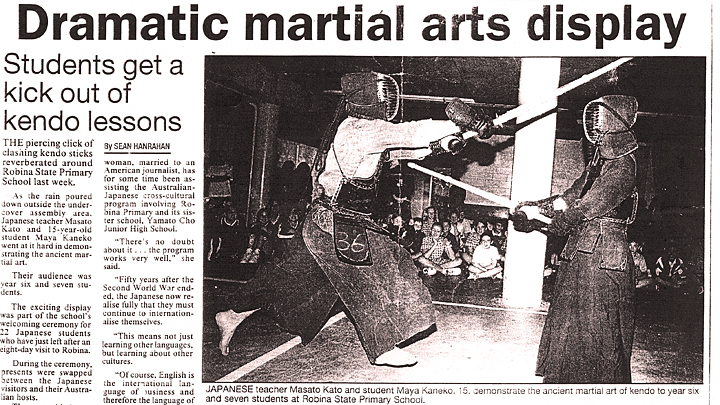
    『華麗な武道実演、児童ら剣道実演に大喜び』

    州立ロビナ小学校で先週、竹刀を打つ鋭い音が校内に響き渡った。激しい雨が会場の屋根に叩きつける中、この日本古来の武道を見学した。この白熱の剣道実演は、日本からロビナを訪問した生徒22人の歓迎式典の一環として同校で行われた。生徒たちは8日間の滞在後、帰国した。

    満足げに式典の進行を見守るのは、教師・児童心理学者で企業経営者でもある、カズ・ドレイクさん。アメリカ人ジャーナリストを夫に持つ、この小柄な日本人女性は、豪日文化交流プログラムを幾度も支援してきた。ロビナ小学校と、姉妹校である大和中学校の交流もそのひとつである。

    ドレイクさんはこう語っている。「この交流プログラムは、大変うまくいくと言って間違いないでしょう。第二次大戦後、50年たった現在、日本人は、日本の国際化を進める必要性を痛感しています。これは、外国の言葉だけではなく、文化も学ぼうというものです。英語は言うまでもなくビジネス世界の国際語ですから、最も重要な外国語であると日本人は思っています。」

    1994年、大和町がある岐阜県の教育関係者が視察のため来豪。それ以来、大和町とロビナは活発に交流を行ってきた。大和町は、寺社仏閣で名高い京都より、車で1時間ほどの所にある。ロビナ小学校のポール・バード校長の視察団への申し入れにより、早速、両校を通じた姉妹町提携が結ばれた。それ以来、ロビナ小学校の児童が、毎年日本を訪れるようになった。児童たちは、日本人家族で生活し、大和町で学ぶという体験を満喫している。大和町の生徒たちも毎年、ロビナで同様のプログラムに参加している。今年は大和町から、カトウ先生、サカイ、ケンジ校長、ワダヨシマサ先生の引率で、22人の生徒がロビナを訪れた。大和町のキティ・ウォンさんは、3年間の訪問以来、ロビナ小学校や当時のホストファミリーと連絡を絶やさなかった。そして、州立ロビナ高校に入学する為に再びゴールドコーストにやって来た。ロビナ小学校からは今年、7年生MBクラスのジャレッド・モスリー君(12)が訪日。2週間剣道を学んだ後、10日間の交流訪問を行った。ジャレッド君にとって2度目の日本行きは、ドレイクさんの会社の奨学金によって実現した。本気で日本の文化を学ぶ熱意がうかがえたからだという。例えば日本食ですが、ジャレッド君は、どんな料理が出ても試してみようという姿勢が感じられました。」

    「ドレイクさんによると、来豪した日本の生徒はおもしろいことに、オーストラリア人家庭での生活を非常に有意議だと感じ、オーストラリアの子供が両親を敬うことに関心するという。

    掲載記事:豪クイーンズランド州ゴールドコースト発行「サン」紙掲載記事より
    記者:ショーン・ハンラハン


    写真:留学剣道レッスン

    Dramatic martial arts display

    Students get a kick out of kendo lessons

    THE piercing click of clashing kendo sticks reverted around Robina State Primary School last week.

    As the rain poured down outside the undercover assembly area, Japanese teacher Masato Kato and 15-year-old student Maya Kaneko went at it hard in demonstrating the ancient martial art. Their audience was year six and seven students. The exciting display was part of the school’s welcoming ceremony for 22 Japanese students who have just left after an eight-day visit to Robina.

    During the ceremony,presents were swapped between the Japanese visitors and their Australian hosts. The assembled students enjoyed several popular songs by the school band, as well as some cappella performances by the Japanese students. Teacher, child psychologist and businesswoman, Kaz Drake, watched the proceedings with obvious satisfaction. The tiny Japanese woman married to an American journalist, has for some time been assisting the Austrian-Japanese cross-cultural program involving Robina Primary and its sister school, Yamato Cho Junior High School.

    “There’s no doubt about it… the program works very well,” she said. “Fifty years after the Second World War ended, the Japanese now realize fully that they must continue to internationalize themselves. “Of douse, English is the international language of business and therefore the language of most importance to the Japanese.”

    The Yamato Cho-Robina connection has flourished since a fact-finding visit to Australia in 1994 by educationalists from the Gifu Prefecture, where Yamato Cho is located. This is about an hour’s drive from the sacred city of Kyoto. Robina Primary’s principal, Paul Bird, spoke to the visitors and a sister city relationship between the two schools quickly developed. Since then, Robina students have spent time in Japan every year. They have enjoyed the opportunity of staying with at Yamato Cho. Japanese students of Yamato Cho have done the same here every year. The 22 Japanese students who visited Robina this year came with Mr Kato; Yamato Cho’s principal, Mr Kenji Sakai; and another teacher from Yamato Cho, Mr Yoshimasa Wada. Many ongoing relationships between the Japanese and the Australians have also developed over the years. Yamato Cho’s Kitty Wong kept open the lines of communication between herself and Robina Primary and family she stayed with here three years ago before moving to the Coast to become a student at Robina State High School. This year, Robina Primary 7MB student, Jared Mosley, spent two weeks in Japan studying kendo, following a 10-day exchange trip there.

    Mrs Drake said Jared, 12, made his second trip on a scholarship provided by her company because he was ‘really interested in the Japanese culture’. “That included the food… I think he tried every single dish he came across!”
    Interestingly, Mrs Drake said the Japanese students who visit Australia find family life here very rewarding and respect young Australians have for their parents.

    By Sean Hanrahan

  • 豪日小学生、和太鼓でインターネット中継

    『ネットワード・インターナショナル・サービス(以下、Netword)』『パシフィック異文化教育アカデミー(以下、PCA)』がメディア掲載、取材等で取り上げられた記事を紹介致します。
    以下、掲載記事


    CEC – Requested Project – Australia #3 October, 1998.

    Primary School Exchange Through Music

    Requesting school:Enzan Primary School in Fukui Pref.

    Purpose:To promote and enhance international communication and exchange understanding through playing music.

    Partipants:Enzan P.S. – Grade 5(12 boys and 15 girls)

    Date:November 10th(Tuesday), 1998

    Theme:To celebrate rich haves of rice in the fields near their school.

    They call it “KOME KOME FESTA”

    (come means rice, festa – festival) Students compose and practice festive songs.

    They would like Australian students to perform instruments symbolizing Australia, like Aboriginal music with it’s instruments if possible.

    They believe that even if their music is a mutual communication tool that this kind of project for their primary students sharpens different cultures as they can’t start studying English until they go to junior high school.
    Communication devise:Internet – CU-See Me with telephone.


    21世紀、学校の姿は

    和太鼓演奏 ネットで豪州に
    児童が教え合い公開授業で紹介(福井円山小)

    写真:朝日新聞[1998.11.10]
    写真:リアルタイムで音と映像が豪州に届いた=福井県四ツ井3丁目円山小学校で

    二十一世紀を展望した教育に取り組んでいる福井市四ツ井三丁目の円山小学校(宮崎好運校長
    )で、公開授業などの教育研究発表会がこのほど開かれた。国際化や情報化がさらに進むのに即応した教育のあり方を探るねらいで、今後の参考にしようと、県内外から教職員ら約二百五十人が同校を訪れて見学した。
    公開授業をしたのは、一、三、五年生。一年生は算数の授業で学んだ知識を生かして、ゲーム感覚で数量計算や図形を学んだ。三年生は、児童同士がそれぞれの得意分野で教え合う授業を展開した。二〇〇二年度から始まる「総合的学習」を先取りした形で、一輪車や料理、芸術など、各教室では児童自らが”先生”になり、教え方などを工夫しながら勉強した。
    五年生のあるクラスは、インターネットを使って豪州の児童と交流した。「音楽や絵画は世界共通の言語」と、児童らは和太鼓の演奏を披露。これに対して、豪州の児童らはコーラスで返した。交流後、双方の児童らは「すばらしい演奏だった」「とてもきれいな歌声だった」とたたえ合い、今後の交流も約束した。
    円山小学校は、一九九六年度に福井市教委の「二十一世紀の学校づくり推進校」の指定を受け、児童の個性、自主性を尊重した授業を進めている。乾昭治教頭は「国際化、情報化が一層進む今後は、これまで以上に自分の考え方や力を伝えていくことが大切になってくると思うので、できる限り子どもの側に立った教育をしていきたい」と話していた。

    参照:朝日新聞【1998.11.10】


    マルチメディアで国際交流

    豪の児童に和太鼓披露
    円山小が研究発表会

    マルチメディアを積極的に取り入れている福井市の円山小(宮崎好運校長)の自主研究発表会が十日、同校で開かれた。コンピューターを駆使した授業などを県内外の教育関係者約二百三十人が見学、五年性の授業では、テレビ会議システムを使ってオーストラリアの小学校とパソコンを通じ交流した。同校はパソコンを四十二台配置するなど児童に積極的にマルチメディアに触れさせている。
    公開授業は、一、三、五年で行われた。このうち、五年三組の総合科目の公開授業では、オーストラリアのクイーンズランド州の「オール・セイント・アングリカンスクール」とテレビ会議システムで接続、市の国際交流員に通訳を務めてもらい、モニターを通じて会話を交わした。
    さらに円山小側からは、児童二十七人による和太鼓などの演奏を送信。また逆にオーストラリア側からは、児童によるコーラスやバイオリン、オルガン演奏が披露された。
    途中、モニターテレビが消えてしまうなどのハプニングがあったものの、先進的な授業とあって、見学者は授業の様子をビデオやカメラに収めるなど、熱心に見ていた。
    兵庫県尼崎市立花南小の楢原八恵美教論は「円山小はインターネットを行うというので関心があった。情報化だけでなく国際交流の実践例を見られてよかった」と話していた。

    記事:福井新聞【1998.11.10】


    豪の児童と交流授業

    福井・円山小 テレビ会議システムで

    二十一世紀に向けた学校づくりを展望した教育研究発表会が十日、福井市の円山小(宮崎好運校長)で開かれた。県内外から小中学校の教員ら約二百五十人が同校を訪れ、一、三、五年の各学年でテレビ会議システムやコンピューター、ビデオなどの各種メディアを活用した授業や、マルチメディアを生かした学校づくりについてのシンポジウムが行われた。
    同校では、「一人一人の思いが輝き 共に創り出す学校」を研究主題に、表現やコミュニケーション活動を重視した学校づくりを展開。児童が主体的に学習、表現する手段として各種メディアを活用している。また、児童の主体的な学習を支援するため、チームティーチングや総合学習の要素も取り入れている。
    このうち、五年三組の児童は、テレビ会議システムを使って、オーストラリア・ゴールドコースト市の小学校の児童と音楽を通して交流を深めた。互いに通訳を通して学校のことを紹介し合った後、最初にオーストラリアの児童が合唱を披露。これにこたえて円山小の児童は、自分たちで作曲した和太鼓の曲を演奏し、八十キロの距離を越えて”セッション”を繰り広げた。
    また、一年生は数遊びづくりの授業を、三年生は、野球や一輪車など児童一人ひとりが得意なことを教え合う教室づくりの授業を、学年全員が参加して行った。両学年とも、クラスとは別に同じ思いを持つ児童が集まったグループ単位で学習が進められ、児童らは自分が考えた遊びなどを生き生きとほかの児童に伝えていた。

    記事:新聞記事【1998.11.10】